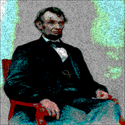
Abraham Lincoln
Biography of Abraham Lincoln
Full Name and Common Aliases
Full Name: Abraham Lincoln
Common Aliases: Honest Abe, The Great Emancipator, The Rail-Splitter
Birth and Death Dates
Born: February 12, 1809
Died: April 15, 1865
Nationality and Profession(s)
Nationality: American
Profession(s): Lawyer, Politician, 16th President of the United States
Early Life and Background
Abraham Lincoln was born in a humble log cabin in Hardin County, Kentucky, which is now part of LaRue County. His parents, Thomas and Nancy Hanks Lincoln, were farmers who struggled to make ends meet. Lincoln's early life was marked by hard work and limited formal education. Despite these challenges, he was an avid reader and taught himself much of what he knew. The family moved to Indiana in 1816, where Lincoln's mother died when he was just nine years old. His father remarried, and his stepmother, Sarah Bush Johnston, encouraged his education and love for reading.
Lincoln's early experiences with manual labor, including splitting rails for fences, earned him the nickname "The Rail-Splitter." These formative years instilled in him a strong work ethic and a deep understanding of the common man's struggles, which would later influence his political career.
Major Accomplishments
Abraham Lincoln's most significant accomplishment was his leadership during the American Civil War, a tumultuous period that threatened the very fabric of the United States. Elected as the 16th President in 1860, Lincoln faced the secession of Southern states and the outbreak of war. His steadfast commitment to preserving the Union was unwavering, and he navigated the nation through its darkest hours with determination and resolve.
One of Lincoln's most notable achievements was the issuance of the Emancipation Proclamation in 1863, which declared the freedom of all enslaved people in Confederate-held territory. This pivotal action not only altered the course of the war but also redefined the nation's moral compass, setting the stage for the eventual abolition of slavery.
Notable Works or Actions
Lincoln's presidency was marked by several key actions that have left an indelible mark on American history. His Gettysburg Address, delivered in 1863, is one of the most famous speeches in American history. In just 272 words, Lincoln eloquently reaffirmed the principles of liberty and equality, emphasizing the importance of national unity and the sacrifices made for freedom.
In addition to his wartime leadership, Lincoln signed the Homestead Act in 1862, which provided 160 acres of public land to settlers, promoting westward expansion and development. He also established the National Banking System, which laid the foundation for a more stable and unified economy.
Impact and Legacy
Abraham Lincoln's impact on the United States is profound and enduring. His leadership during the Civil War preserved the Union and set the nation on a path toward healing and reconstruction. The Thirteenth Amendment, which abolished slavery, was passed shortly after his assassination, fulfilling his vision of a nation free from the bonds of slavery.
Lincoln's legacy extends beyond his political achievements. He is remembered as a symbol of integrity, humility, and perseverance. His life story, rising from humble beginnings to the highest office in the land, embodies the American Dream and continues to inspire generations.
Why They Are Widely Quoted or Remembered
Abraham Lincoln is widely quoted and remembered for his eloquence, wisdom, and moral clarity. His speeches and writings, characterized by their profound insight and timeless relevance, continue to resonate with people around the world. Lincoln's ability to articulate complex ideas in simple, powerful language has made his words enduring symbols of hope, justice, and equality.
His quotes, such as "Government of the people, by the people, for the people, shall not perish from the Earth," encapsulate the democratic ideals that define the United States. Lincoln's legacy as a leader who championed human rights and national unity ensures that his words remain a source of inspiration and guidance in times of challenge and change.
Quotes by Abraham Lincoln
Abraham Lincoln's insights on:

And in as much as most good things are produced by labor, it follows that such things of right belong to those whose labor has produced them.

There is no permanent class of hired laborers among us. Twenty-five years ago, I was a hired laborer. The hired laborer of yesterday labors on his own account today, and he will hire others to labor for him tomorrow.

All that love's labor serves the nation. All that harms labor is treason to America. There is no America without labor, and to fleece one is to rob the other.

My childhood home I see again, / And gladden with the view; / And still as mem'ries crowd my brain, / There's sadness in it too. / O memory! though mid-way world / 'Twixt Earth and Paradise / Where things decayed, and loved ones lost / In dreamy shadows rise.

You can fool some of the people all of the time, and all of the people some of the time, but you cannot fool all of the people all of the time.

I remember my mother's prayers and they have always followed me. They have clung to me all my life

As I said before, this crisis is all artificial. It has no foundation in facts. It was not argued up, as the saying is, and, cannot, therefore, be argued down. Let it alone and it will go down of itself.


Upon the subject of education. I can only say that I view it as the most important subject which we as a people may be engaged in.

I know that there is a God and I see a storm coming. If he has a place for me, I am ready.